


Categories: Other Meditation Teachings
May the blessings of the Triple Gem be with you all!
Today, I wish to speak with you about our journey through what we call Samsara the long, cyclical journey of existence. For those of you who hold faith and confidence in the teachings of the Buddha, you understand that life is not just a single event. We are part of a cycle of rebirth and death, reappearing in various forms of existence over and over again.
As we travel this path, we accumulate all kinds of experiences and perform many actions, some good and some unskillful. The unskillful, or wrongful, actions can manifest as what we might call ‘samsaric faults’ or deep karmic imprints that affect our journey. Today’s teaching is intended to bring some clarity to this profound topic.
You know that this journey of Samsara is incredibly long. If we try to look back at our past, the distance we have traveled is immeasurable. The Buddha himself taught that we cannot pinpoint a beginning or an end to this cycle; it is that vast. This truth is universal, applying to every one of us. It doesn’t matter if you believe in it or not. Even for someone who thinks, ‘There is no such thing as Samsara,’ the reality remains the same.
Whether you are born a Buddhist or follow another faith, this cosmic law applies. A person may hold a different view and believe in it strongly, but the nature of Samsara is the same for them, because the ultimate reality of the world cannot be twofold. There can only be one truth for the universe, for nature, and for the law of karma. People may develop various opinions and views based on what they see and hear after they are born, but please remember this clearly: there is one fundamental truth to this universe and this natural order.

What Are These Karmic Imprints?
Within this beginningless Samsara, we have performed countless actions. If we don’t bring this journey to an end, if we don’t stop it, there is no telling how much further we will travel. We cannot simply decide, ‘I will end this in my next life’ or ‘I will end this in a specific human birth.’ The end is determined by the actions we perform in our present existence. This is a point you must deeply understand and have confidence in.
Therefore, if we are working to end this journey, we can see signs that we are getting closer to understanding the ultimate truth in a near future life. But if we have no such inclination, no such training within ourselves, we can never set a limit on when this journey will end.
When we speak of ‘samsaric faults,’ we are referring to the unwholesome side of our actions. As we journey, we engage in various unskillful actions, which in Buddhism are called akusala kamma. It is these unwholesome actions that return to us as results, or vipaka. We see these results as the deep karmic imprints that shape our lives.
In the world, there are also various esoteric arts and occult sciences that try to analyze the unseen aspects of life. Whether it is through shrine-based traditions or other practices even reading a horoscope is a form of this these systems often identify these samsaric faults as ‘afflictions’ or misfortunes. In this way, all of us have various deep-seated karmic imprints taking shape within us. Our task is to systematically reduce these accumulated faults. Starting from this very human life, we must ensure that such actions are not repeated.
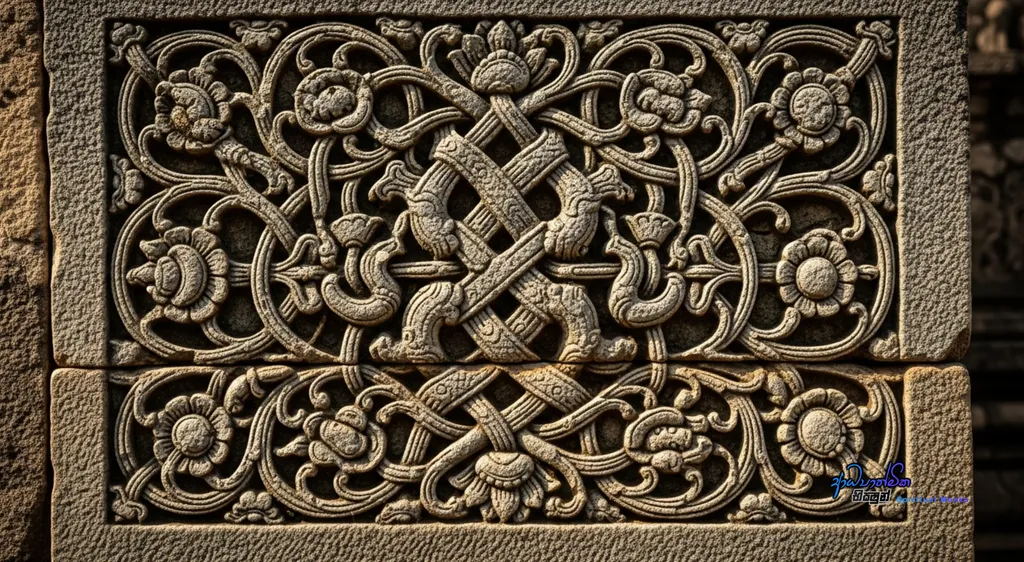
Why Do We Suffer? Seeing Past Imprints in Our Present Lives
We may have done unwholesome things in past lives. Those actions are now done, but their karmic energy remains, and we are left to experience the results. Perhaps in this very life, you are experiencing immense suffering. Perhaps in your family life, whether as a husband or a wife, you lack the mental peace and happiness you desire. You might face difficulties with your children or your parents.
You might be struggling with financial problems or illnesses. You may have become someone who is both mentally unhappy and physically in pain. What do you see as the cause of all this? Often, it is the karmic imprints from our past in Samsara that are now ripening.
Then you look at someone else, and you see them living a very happy family life. They may not have a lot of money, but as a husband and wife, with their children, they live in harmony and happiness. Or perhaps they do have money and enjoy life with it. They have nice vehicles that are pleasing to see, they dine at good restaurants, and stay in fine hotels.
They go on vacations and share their joy on social media. You see these things. You might see people on platforms like YouTube sharing their happy lives, and it becomes clear they are content in their family and also enjoying worldly comforts. Then, you might think to yourself, ‘Why is this happening to me? Why don’t I have a life like that?’
This is precisely the point I want to help you understand. This is not just relevant to those who are married. You may or may not be married; that is a common situation. It doesn’t matter if you are single, a man or a woman living alone. We all have a life. And in this life, we all have certain shortcomings.
There may be areas where we feel complete and happy, but often there are more shortcomings than strengths. The point to grasp is that because we have created karmic imprints in the past, their unwholesome results, their ‘sins,’ have come to us in this life as painful consequences. This is what we mean when we say these are karmic imprints from Samsara. This is a normal phenomenon in the human world.

An Example of Jealousy’s Lasting Stain
If you can understand this, if you can think, ‘This suffering I’m experiencing is due to some fault I created in my past,’ it can greatly help you achieve a correct mental state. For instance, imagine your family life in this birth is failing. Your marriage is ending in divorce. It might be your fault, or it might not be.
It could be the fault of your spouse, or it might not be. But for some reason, your married life is unsuccessful. What is the cause of this failure? If one had the ability to see past lives, like a Buddha or an Arahant or even a layperson who has developed worldly meditative abilities they might be able to see the root cause.
Looking back, perhaps two, three, or even ten lives ago, you saw a couple living a beautiful, happy life together. A feeling of jealousy arose in you. You befriended the wife and began to plant seeds of doubt about her husband. You told her false stories and negative ideas, and because of your friendship, she began to believe you.
She started to argue with her husband, to doubt him. This continued, escalating beyond any resolution. And you, seeing this, felt happy. You continued to fuel the fire, as we say, ‘adding straw to a burning flame.’ Eventually, the family was torn apart. You rejoiced when you saw them fighting, and you rejoiced again when they separated. Such things happen in our world today; we see and hear of them often.
After an act like that, the unwholesome karma has been created. It becomes one of your deep karmic imprints. Now, ten lifetimes later, in this human birth, you may not be trying to ruin anyone’s marriage. You might see happy couples and feel glad for them, even helping them. However, the powerful unwholesome energy from that past life has ripened and is strong enough to bear its fruit, no matter how much good you do now.
Please do not misunderstand this to mean that doing good deeds is pointless. That is not true. Your good deeds, your merit, will absolutely bring their own positive results, either in this life or the next, until you finally end the journey of Samsara by realizing Nibbana. To think otherwise would be foolish. In this way, these karmic imprints from our past come to us.
Karma: Your True Inheritance and Refuge
Always remember what the Lord Buddha taught us, as recorded in the Sutta Pitaka of the Tipitaka: we are the heirs of our karma. He says to believe that ‘karma is our own, karma is our heritage, karma is our refuge.’ This means that besides our intentional actions, there is no other true foundation. This is why, when you make an offering, like a food donation, the monks will advise you to do so with faith in karma and its results (kamma-phala) and instruct you on how to maintain the right state of mind. This is the correct way. You should act with the understanding that every action has a consequence.
However, the Buddha also clearly taught that we should not perform good deeds with the expectation of worldly rewards. We shouldn’t do good things hoping for material gain. Instead, we should act with the simple, firm conviction that there are results of karma.
If you can cultivate this understanding regarding your current situation, it will be immensely helpful in developing a healthy mindset. You can learn to think, ‘This is a fault I created in Samsara that has come back to me.’ If we can understand this journey through Samsara, we can proceed on our spiritual path with great confidence and clarity. That is the essence of this teaching.
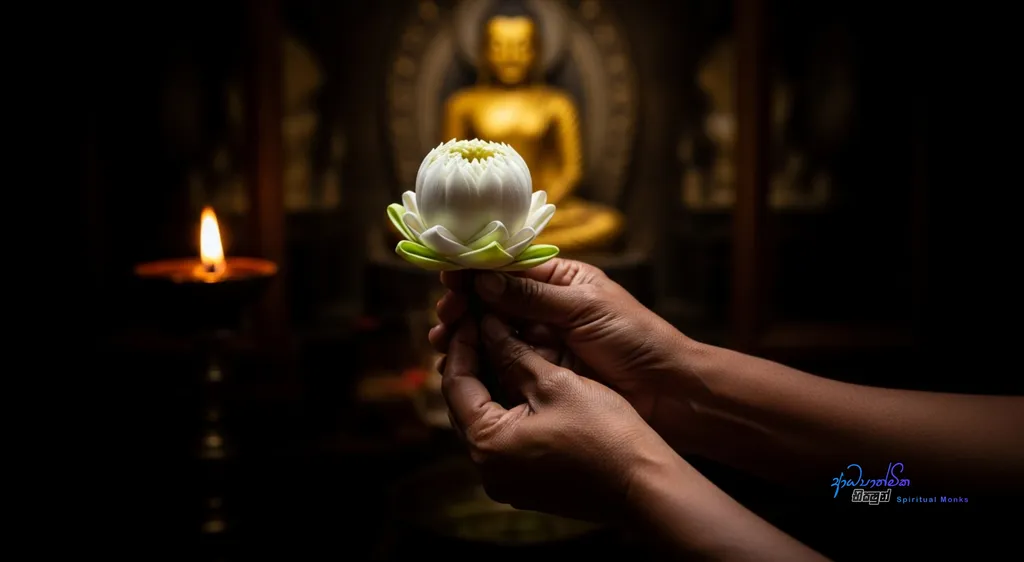
The Echo of Harming Another’s Home
This topic of karma is vast and complex, and this teaching could take a very long time. But I will provide what is necessary for you to reflect upon. Let’s consider another example of how karmic imprints are formed. Imagine that in a past life, you saw someone build a beautiful house.
A sense of envy arose within you. In those days, just as today, there were people in society, especially in our Sinhala society, who would resort to primitive means when they saw others prosper. They would use sorcery or black magic (what we call anavina kodivina) and bind non-human entities (amanussa) to the property to cause misfortune. They might conspire with the builder to place cursed objects under the foundation. There are people who do such despicable things.
Ironically, those who perform such acts often have no prosperity themselves. They might live in mud huts or unfinished houses. They may be childless and lack any success in life. This is because of the faults they themselves have created in previous lives. Yet, in this life, unable to understand their own jealousy, they continue to accumulate more faults by envying others from every angle. After they have bound these non-human entities to a home, the family living there begins to face problems. The non-human spirit acts according to its binding, and progress in the home stalls.
Conflicts arise between husband and wife. The children and parents cannot stand the sight of each other. There is a constant feeling of irritation. The children’s education fails. The parents face pressure and stress at their jobs. Businesses collapse. The people who caused this then rejoice, thinking, ‘Serves them right.’ There is a segment of society that will stoop to destroying homes and families in this way. This existed in the past, it exists today, and it will likely exist in the future.
Now, imagine you did something like that in a past life. As a result, in your current life, your own family may be facing all kinds of problems. I am not suggesting that someone has put a curse on your house now that may or may not be the case. Your house could be completely free of such issues. However, the karmic imprints you created in the past by destroying another family’s peace can still ripen.
As a result, your family life could be failing, with no harmony or understanding between you and your children. Everyone is argumentative, and there’s no sense of satisfaction. Your finances could collapse. These are the kinds of problems that arise from such deep-seated karmic imprints. We all have these faults to varying degrees. And when you see families who live beautifully and harmoniously, it is because they have not created such negative karmic imprints in their past.
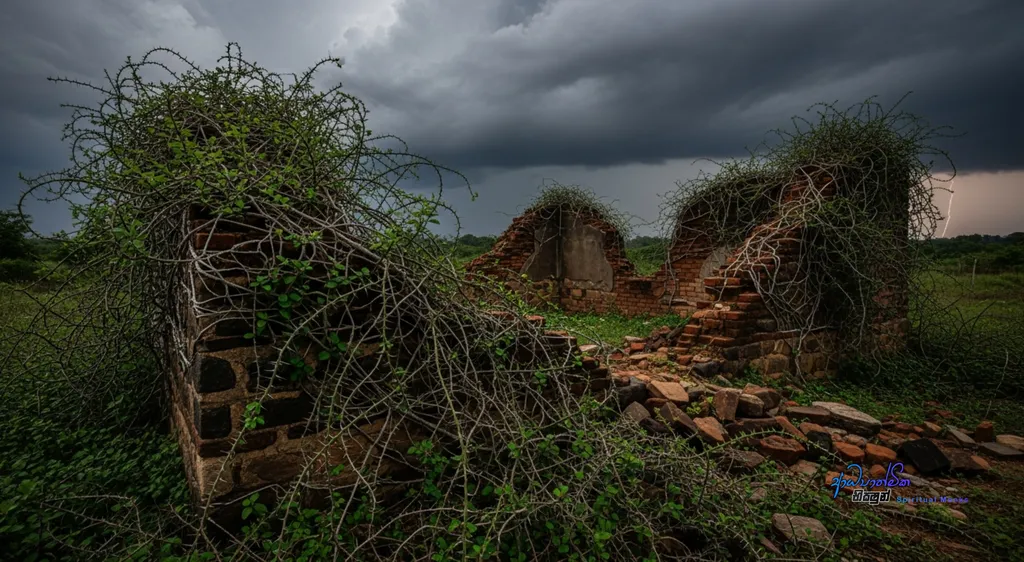
The Immediate Karma of Harming Living Beings
These karmic imprints manifest in countless other ways. For example, perhaps you are someone who has been in a road accident and is now bedridden with broken limbs. If we were to look at a past life, it’s possible you caused similar harm to another person or an animal.
Perhaps you went hunting for sport or for food. To get the meat and skin, you may have cruelly tortured and killed animals. You might have shot them. For example, you know that before a pig is slaughtered, it is often beaten severely to make its hide swell, which is said to improve the meat. You might have been someone who did this.
There is a story from the time of the Buddha, near the Jethavana monastery in Savatthi. There lived a man named Cunda the pork-butcher (Cunda Sūkara). It was said that the screams of the pigs he slaughtered could be heard every day at the monastery. If you read the ancient commentaries, like the Dhammapada commentary, you can find this story in rich detail. Cunda earned his name because his trade was slaughtering pigs. In the end, on his deathbed, he himself died screaming like a pig.
Even in society today, we hear of such things. In some villages, there are men whose profession is hunting in the forest. When their unwholesome karma begins to ripen late in life, a common fate for them is to be injured by the very trap-guns they set for animals. This is what we call diṭṭha dhamma vedanīya kamma karma that gives its results in this very life. The same gun that killed so many animals turns on them. They become bedridden, crippled by the leg, just like the animals they hunted…

We invite you to walk this path with us. Read our teachings, and most importantly, apply them practically in your own life. as you practice, questions will naturally arise. Please feel free to share your experiences and questions in the comments below, via email or contact form. I will do my best to offer guidance in future talks based on your progress. For now, begin this practice with an open heart and a mind free from expectation. Cultivate it correctly, and may you find the clarity and peace you seek.
Thank you for joining us. We hope this blog will be of great benefit to your spiritual journey.
May you all be well and happy.
May the blessings of the Triple Gem be with you all!.


