


Categories: Eradicate the Fear of Meditation
May the blessings of the Triple Gem be with you all!
Welcome. Through our teachings, we have consistently aimed to guide you on a practical spiritual journey. The goal has always been to help you elevate your mind, to develop higher levels of concentration, known as Samādhi, and to reach profound meditative states, or Jhāna. We’ve offered practical methods to help you identify troublesome thoughts, and ultimately to eradicate the mental defilements, or kilesas, that cause you suffering.
Many of you have experienced the practical benefits of these teachings and have shared your progress with us, for which we are grateful. This development is precisely what we hope for the growth and enhancement of your spiritual journey.
Today’s topic is especially for those, particularly the younger generation, who are interested in spirituality but have become trapped within a limited or mistaken framework. My hope is to clarify these misunderstandings from the perspective of a practical spiritual life. The title of this teaching, ‘From a Blessed Thread to Nibbāna,’ encapsulates the entire path. If you read this article with an open mind, you will gain a clear understanding of these matters.
You will see how the practices of the past and present Buddhist tradition contribute to our well-being in this life, the next, and ultimately lead to Nibbāna the final liberation. I invite you to explore this teaching fully, as there is much of value to be gained.
The Seeker’s Awakening: A Chance Encounter at a Temple
Let’s begin with an example. Imagine a man or a woman who does not even keep the Five Precepts the basic ethical guidelines in Buddhism. This person has indulged in every aspect of worldly life. They have deeply explored sensual pleasures, known as kāma.
If a woman, she has known many men; if a man, many women, fully immersing in sexuality. Yet, despite having everything money, parties, international travel, and all the things we call ‘enjoyment’ a sense of incompleteness begins to dawn on them. You can even picture yourself in this scenario. You’ve experienced it all, but something is still missing.
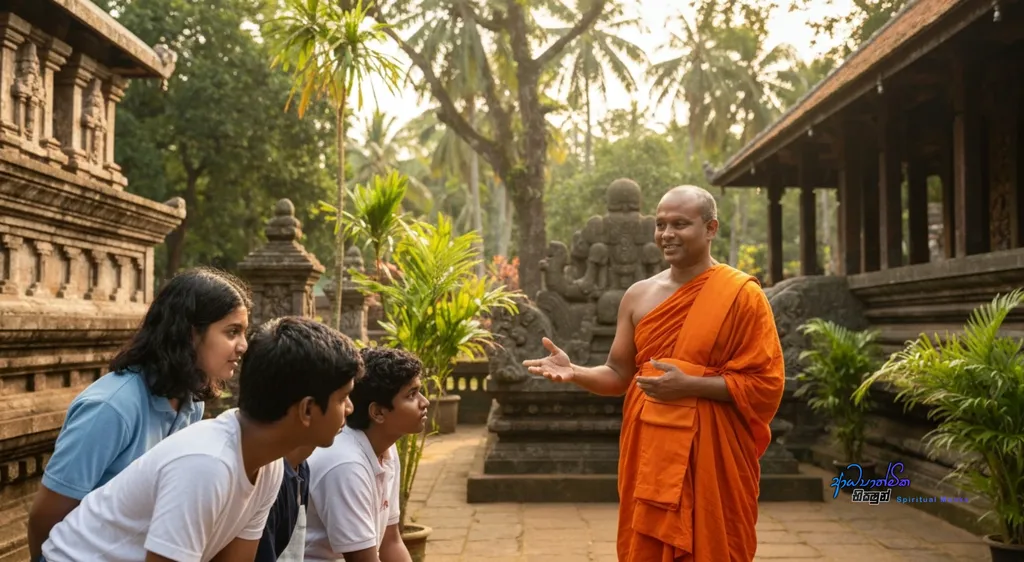
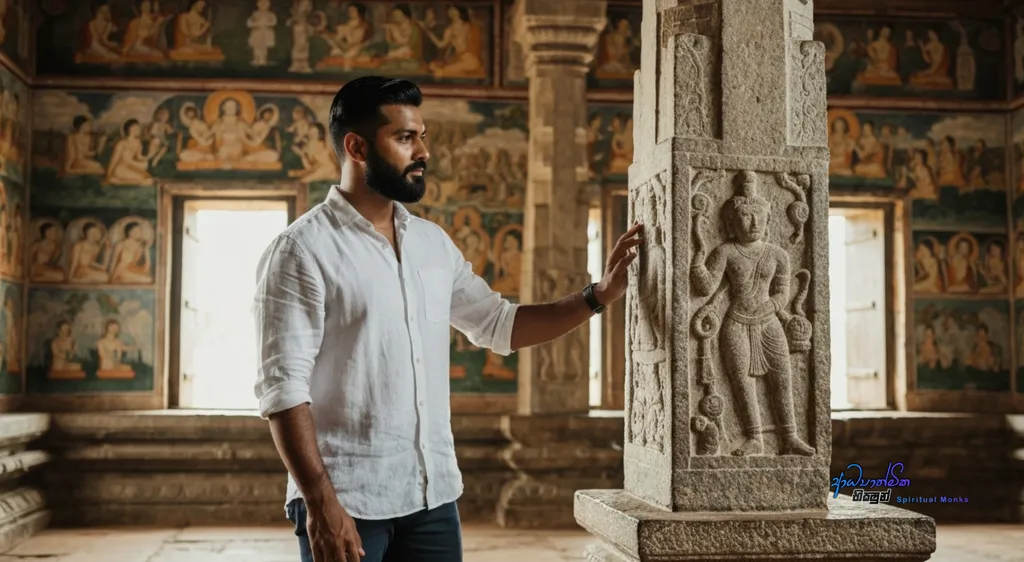
One day, during a trip, this person, who might be of another faith or perhaps a Buddhist in name only, wanders into an ancient monastery. They are captivated by the antiquity of the place the ancient murals, the stone pillars, the ruins of old buildings.
A thought arises: ‘Our ancestors were not an undeveloped people; they were a highly advanced civilization.’ As these thoughts emerge, this intelligent person notices a monk. This is not just any monk. Let’s imagine he is a monk with spiritual abilities, who has cultivated deep meditative states (Jhāna), awakened his inner spiritual energy (Kundalini), and perhaps even attained stages of enlightenment (magga-phala).
Of course, the depth of this monk’s mind is not visible on the outside. All one can see is his serene demeanor, the way he wears his robes, and the peaceful, joyful expression on his face that reflects his inner purity. It doesn’t matter if he is dark or fair; the purity of his mind makes him radiant. The seeker, whom I call ‘intelligent’ because they possess a worldly wisdom and neutrality that allows them to see beyond the surface, approaches the monk.
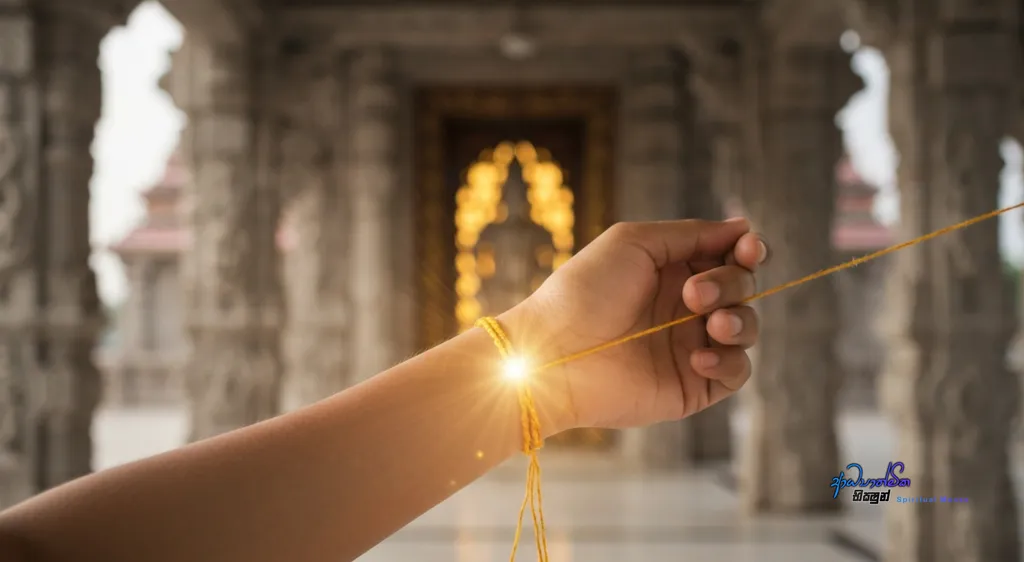
After a pleasant conversation, as the visitor prepares to leave, the monk offers a small gift: a blessed thread, known as a pirith noola, which he ties on their wrist. For someone who has never worn one, this simple act sparks a feeling of joy and appreciation a small blessing has been received.
The Surprising Power of a Simple Blessed Thread
Now, let’s talk about this blessed thread, the pirith noola. Some people look down upon such traditions, but this is a mistake. The blessed thread is incredibly valuable for healing the mind. When protective verses, or pirith, are chanted in the original Pāli language of the Buddha’s teachings, they emit a powerful frequency. You could say it is one of the most powerful, weighty, and potent vibrations in the universe stronger than any weapon. This can often be perceived by those who have awakened their ‘third eye’ or inner vision.
Scientific studies, like those conducted in Japan on blessed water, have shown that the molecular structure of water changes when exposed to the vibrations of Pāli chanting. You can find this research online. The power of a blessed thread is directly related to the virtue of the person chanting over it.
Consider this hierarchy of spiritual power:
The Hierarchy of Blessings: From Virtue to Enlightenment
- An immoral person (lay or monastic) chants. A frequency is still generated from the Pāli words, but its power is minimal and fades very quickly.
- A virtuous person (sīlavā) who keeps the precepts chants. The power is significantly stronger and lasts longer.
- A person with both virtue (sīla) and developed concentration (samādhi) chants. The power is greater still.
- A person with virtue, concentration, and psychic abilities (adhimānasika) chants. The power increases even more.
- A person who has also mastered meditative absorptions (jhāna) chants. The power is immensely potent.
- An enlightened being a Stream-enterer (Sotāpanna), Once-returner (Sakadāgāmī), Non-returner (Anāgāmī), or a fully liberated Arahat chants. The frequency of their blessing is profoundly powerful.
- A Buddha, a Solitary Buddha (Paccekabuddha), or a Great Arahat chants. A single blessing or resolution from such a being can last a lifetime, or even millennia. It only fades when the object itself decays according to its nature.
This is because these beings have realized and aligned with the natural law of the universe, the Dhamma. They don’t try to go against nature; they understand it perfectly. The Buddha is the one who has awakened to this reality most completely, followed by Paccekabuddhas and Arahats. Their power comes from this profound realization, which makes their blessings, like the one that protects the Ruwanwelisaya stupa for 5000 years, so enduring.

Māra’s Deception: The Attack on Buddhist Traditions
So, when our seeker receives the thread from a highly realized monk an Arahat with mastery of jhāna and psychic powers something profound happens. Any negative, non-human entities that may have been invisibly attached to the seeker, feeding on their sensual energies, are immediately driven away.
The seeker’s mind becomes calm and peaceful, infused with the monk’s powerful spiritual energy derived from his virtue, concentration, and liberation. A thread blessed by a virtuous monk can hold its power for about three months. A thread from an Arahat can last a lifetime. A blessing from a Buddha is beyond measure.
Now, you can see how powerful and helpful these foundational practices are on the spiritual journey. However, there are forces that wish to destroy this path. This force is what we call Māra the tempter, the adversary to enlightenment. Māra works by introducing the idea that Buddhism is ‘just a philosophy,’ encouraging people to scorn these very practices. You must understand this strategy.
Never criticize these traditions, because people are at different stages of their spiritual journey. This world contains beings who will attain enlightenment in this very life, and others who are still accumulating their spiritual perfections (pāramitā).
Someone who has genuinely realized the truth, who has walked the steps of this path, would never, ever ridicule practices like offering flowers at a Bodhi tree (Bodhi pūjā) or other cultural traditions like the Perahera processions. They understand the immense good these practices do. They may advise not to get stuck at that level, just as one is advised not to cling to meditative states but to keep progressing. But they would never say, ‘Stop doing them.’

The Dangerous Fallacy: Enlightenment Without Renunciation
This brings me to a critical point. There is a group of people, often wealthy and worldly, who want to attain enlightenment, or Arahatship, while continuing to indulge in the world of sensual pleasures (kāma loka). They don’t reject everything in Buddhism; they pick and choose what suits them. They go to musical shows, nightclubs, and engage in sexual relationships, all while claiming to be on a spiritual path. I have met such people.
They promote a dangerous and incorrect idea: ‘We can become enlightened right here in lay life and continue to enjoy all these worldly pleasures. You don’t need monk’s robes (cīvara). You don’t need to live in a forest or a meditation hut (kuṭi). All those things the Buddha taught are unnecessary.’
They often hold wrong views, such as believing there is no past or future life, no karmic journey (saṃsāra), and no need for accumulating perfections (pāramitā). They try to reduce the Buddha to an ordinary man, ignoring his boundless, universal wisdom that surpasses that of any god or human.
Because they cannot comprehend this sublime state, they reject it. They treat Buddhism as a mere philosophy, a kind of ‘positive thinking’ that allows them to remain mired in the mud of sensual desire. This is not the practical path taught by the Buddha.

The True Path vs. The Distorted View
It is true that one can make great progress and even attain high levels of realization in lay life. However, if a layperson were to reach such a state, like full enlightenment, they would naturally gravitate toward renunciation. The path of a householder has its limits. An enlightened one cannot remain entangled in worldly life. The view that one can be an Arahat and continue to indulge in the sensory world is a deep delusion. It is a swamp where one stays stuck.
Therefore, do not be deceived by these wrong views. Engage in the practical path to the best of your ability within your lay life. Practice both tranquility meditation (samatha) and insight meditation (vipassanā). If you are someone accumulating perfections, continue diligently. When the time is right, according to your past wholesome actions your kamma or, more simply, your accumulated merit everything will fall into place. The future you create for yourself will manifest if you act as a correct and sincere person.
I have encountered people holding these distorted views, and it is often impossible to change their minds. They are trapped within their self-imposed limits. If you meet such people, try to guide them if you can. But if they are unreceptive, it is best to let them go. Do not get caught in their web of wrong views. Understand this distinction clearly and proceed on your own correct, practical spiritual journey.

A Final Blessing for Your Spiritual Journey
This teaching is to help you see clearly and avoid these pitfalls. Take what is useful from this discussion and apply it to your life. Understand the value of the entire path, from the simplest act of faith to the highest liberation. I will not extend this teaching further today, as this is sufficient to provide you with the necessary awareness. With the power and blessings of the Buddha, the Dhamma, and the Sanghathe Triple Gem may you all grasp these points clearly and have the strength to walk your own correct and practical path.
We invite you to walk this path with us. Read our teachings, and most importantly, apply them practically in your own life. as you practice, questions will naturally arise. Please feel free to share your experiences and questions in the comments section below, via email or contact form. I will do my best to offer guidance in future talks based on your progress. For now, begin this practice with an open heart and a mind free from expectation. Cultivate it correctly, and may you find the clarity and peace you seek.
Thank you for joining us. We hope this blog will be of great benefit to your spiritual journey.
May you all be well and happy.
May the blessings of the Triple Gem be with you all!


