


Categories: Other Meditation Teachings
May the blessings of the Triple Gem be with you all!
Today, as we gather to explore these teachings, I want to talk about one of the most vital figures in our spiritual lives. When we embark on a spiritual path, whether through devotional acts or dedicated practice, there is one person who helps us begin and sustain this journey. This person is what we call a ‘Kalyana Mitta,’ a noble or spiritual friend.
Whether your path involves tranquility meditation (Samatha), insight meditation (Vipassanā), or even explorations into concepts like Kundalini or universal energy, it is often a spiritual friend who introduces you to these ideas. They might guide you toward developing higher knowledge, such as the ‘divine eye’ (the third eye), the ‘divine ear,’ or the ability to know the minds of others. The person who inspires you to seek these deeper truths is your spiritual friend.
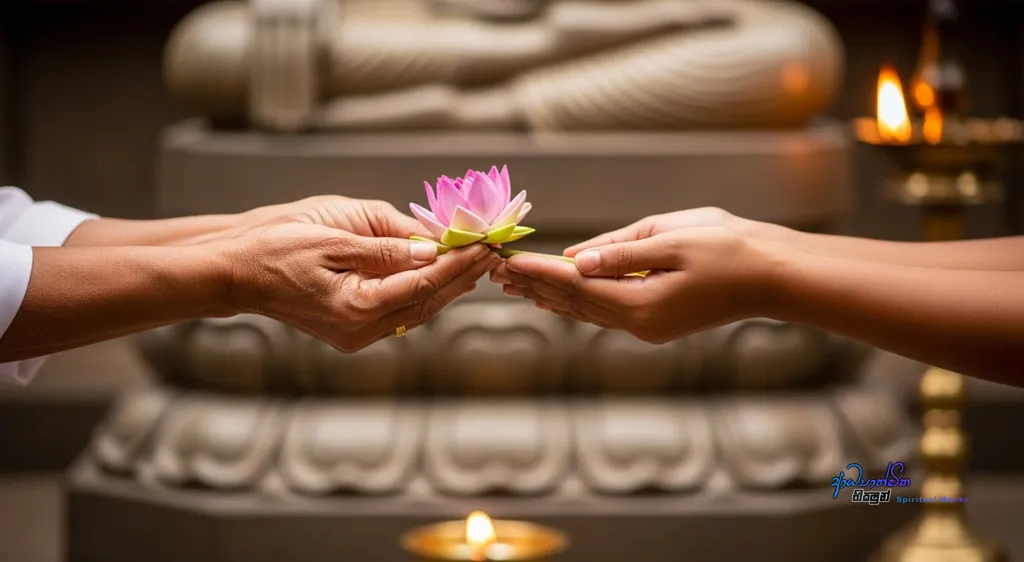
Who Can Be Your Spiritual Friend?
A spiritual friend doesn’t fit a single mold. This guidance might come from a book or a magazine you read. The author becomes your spiritual friend. It could be a teaching you encounter online; in that moment, the teacher on the screen is your spiritual friend. This guidance can come from anyone in your life: a friend, a neighbor, a relative, or even your own parents, siblings, children, or grandchildren. If someone’s presence or actions inspire you to turn toward a spiritual path, they are your spiritual friend.
They might be someone from your workplace, your university, or your school. They can be a man or a woman. It is through the influence of such people that you have likely begun the spiritual journey you are on today.

Beyond Age and Expectations
A common misunderstanding is that a spiritual friend must be someone our own age, like a classmate or a peer. This is not true at all. The Buddha never specified an age for a spiritual friend in the entire Pali Canon, the Tipiṭaka. The person who shows you the correct path could be much older than you, or they could be significantly younger. Of course, they might also be your contemporary.
The defining quality of a spiritual friend is their function: they guide you toward what is wholesome and steer you away from what is harmful. They help you abandon unskillful actions, what we call akusala, and protect you from sin. They encourage you to uphold the Five Precepts (Pañcasīla) the foundational ethics of not harming, stealing, engaging in sexual misconduct, lying, or taking intoxicants. If they see you about to stumble, they gently explain the error and encourage you to refrain.
The Unwavering Support of a True Guide
One of the most beautiful qualities of a true spiritual friend is their unwavering support. As long as you are genuinely trying to improve yourself even if you fall and get back up again and again they will not abandon you. They see your effort, your struggle, and your intention. They will extend a hand to help you rise. This is the special characteristic of a true spiritual friend.
However, there may come a time when even a spiritual friend feels disheartened. If, after receiving endless advice and support, a person shows no interest in even trying to stand up after falling, the spiritual friend may, out of despair, have to let them go. Yet, some spiritual friends possess incredible patience.
They may continue to offer support even when you ignore them, having the wisdom to see that one day, you will eventually turn toward the path. And when that day comes when life brings a turning point and false friends have all disappeared you will finally realize the immense value of the guidance they have offered all along.

Life’s Hardships: The Unlikely Messengers
This experience of hitting rock bottom and finding true guidance is a turning point many of us face. It is especially relevant for those who may have come into this life with a great spiritual purpose, perhaps to fulfill perfections (pāramitā) on the path to enlightenment.
It’s possible to be born with such a purpose and completely forget it, spending a long time lost in worldly pursuits. The painful experiences you gather while lost whether in addiction, greed, or sensual obsession become powerful lessons. Once a spiritual friend helps you change course, the memory of that suffering ensures you never want to turn back.
Often, the catalyst for seeking a spiritual friend is a crisis: the sudden death of a loved one, a painful breakup or divorce, financial collapse, or overwhelming mental pressure. These hardships break down our resistance and open us up to deeper truths. In this way, life’s most difficult moments can act as messengers, pushing us toward the very help we need.
The Dhamma as a Digital Spiritual Friend
In our modern world, the Dhamma (the Buddha’s teachings) can reach us in new ways. An online platform, like the one presenting these articles, can become a spiritual friend for many people around the globe. It offers a refuge. Of course, the digital world contains both good and bad, with unwholesome content often being more prevalent. This reflects the nature of our world in its current cycle of decline, a concept the Buddha explained in teachings like the Aggañña Sutta, which describes how the world and human morality degrade over long periods.
But even in this era, the Dhamma is available. When facing immense mental distress, listening to a song or watching an entertaining video offers only temporary distraction. It doesn’t elevate the mind or equip you to handle future challenges. A spiritual teaching does the opposite.
It doesn’t just soothe you for a moment; it gives you the inner strength to face life’s problems without needing constant external comfort. We have heard from countless individuals, both in Sri Lanka and abroad, who found these teachings during their darkest hours and used them to rebuild their lives, finding a peace that worldly entertainment could never provide.

Wisdom vs. Intellect: Recognizing the True Path
In this age, there is a great deal of intelligence focused on technology and worldly knowledge. However, the Buddha made a distinction between this kind of intellect and true wisdom (paññā). Wisdom is not about earning degrees or creating new technology.
True wisdom is Right View (Sammā Diṭṭhi), the profound understanding of the nature of existence its suffering, its causes, and the path to its end. It is the realization that this cycle of rebirth, or saṃsāra, is unsatisfactory and that there is a way to liberate ourselves from it through the path leading to the stages of enlightenment: Stream-enterer (Sotāpanna), Once-returner (Sakadāgāmī), Non-returner (Anāgāmī), and the fully awakened one (Arahant).
Out of the billions of people on this planet, how many are truly interested in ending this cycle? The ones who understand this deep need, regardless of their religion or background, are the ones the Buddha called ‘the wise.’ Although the number of such people is declining in this era, they still exist. These teachings are offered to support them and to help preserve the Buddha’s dispensation for generations to come.
The Healthy Boundaries of a Spiritual Friendship
A true spiritual friendship is defined by a meeting of minds on the spiritual path, not by age or worldly experience. This alignment of ideas creates a powerful, supportive bond. However, this connection must be free from clinging and attachment.
Many people mistake this deep bond for a conventional relationship, which leads to problems. If you become angry or hurt because your friend doesn’t call you for a few days, it is not a true spiritual friendship. There is no jealousy, no underlying games, no gossip. A true spiritual friend is the same to your face as they are behind your back. They are there when you are in sorrow and rejoice in your happiness from a healthy distance.
It is also crucial to understand that a spiritual friend is not a controller. A common mistake, especially for those new to guiding others, is to become possessive. They might think, ‘You must listen only to the teachers I recommend,’ or ‘You must live your life exactly as I say.’ This is an immature, childish approach. A spiritual friend’s job is to pull you onto the correct path, not to dictate every step you take. Your spiritual journey is your own. You have the right to listen to different teachers and practice in a way that resonates with you.

Your Guide, Not Your Savior
If you find yourself with a spiritual friend who helped you but is now trying to control you, it is important to handle it with wisdom. You must give them the respect and gratitude they deserve for changing your life. Acknowledge it by saying, ‘You are the one who put me on this path.’ But you must also gently and firmly establish boundaries: ‘Please do not try to control my life.’ Likewise, if you are a spiritual friend to someone, do not try to control them.
This is especially important for young people, where a spiritual friendship can wrongly morph into a romantic attachment, causing immense suffering and derailing the spiritual progress of both individuals. Remember, a spiritual friend is like a person who bandages your wound. They help you heal. But they are not expected to wash your feet for the rest of your life, and you should not expect them to.
A teacher provides the teachings, but they cannot carry the personal sorrows of every student. The goal is for you to use the teachings to become strong and independent, able to walk the path on your own feet. Don’t fall into the narrow-minded trap of needing to be special or indispensable to your guide. That is a form of ego. If you and your spiritual friend understand these principles, your connection will be a source of immense benefit.
Please feel free to reflect on your own experiences. Sharing your journey and the lessons you’ve learned can be a great help to others who are on a similar path.
Final Blessings
With the powerful blessings of the Buddha, the Dhamma, and the Sangha the Triple Gem may you all gain the clarity and ability to understand these points and apply them in your lives.
We invite you to walk this path with us. Read our teachings, and most importantly, apply them practically in your own life. as you practice, questions will naturally arise. Please feel free to share your experiences and questions in the comments below, via email or contact form. I will do my best to offer guidance in future talks based on your progress. For now, begin this practice with an open heart and a mind free from expectation. Cultivate it correctly, and may you find the clarity and peace you seek.
Thank you for joining us. We hope this blog will be of great benefit to your spiritual journey.
May you all be well and happy.
May the blessings of the Triple Gem be with you all!.


