


Categories: Four Foundations of Mindfulness: Practical Meditation
May the blessings of the Triple Gem be with you all!
Welcome. In our teachings, we focus on the practical application of meditation, guiding you through both calming meditation (known as Samatha) and insight meditation (Vipassanā). We always strive to explain these methods clearly so you can train effectively. It is always helpful to explore these teachings in order, from the beginning, as this allows for a complete and accurate understanding. This is true whether you are developing a Samatha practice to cultivate calm or training in the Four Foundations of Mindfulness, also known as Vipassanā. Today’s guidance is valuable for those practicing either method, or both.
In many of our discussions, we have explored the concepts of mindfulness (Sati), clear comprehension (Sampajañña), insight (Vipassanā), and the Four Foundations of Mindfulness (Satipaṭṭhāna). Today, our goal is to show you how to apply this knowledge directly in a practical way that is accessible to everyone.
To support this, we have a series of teachings on cultivating mindfulness, including one titled “Silently Watch the Mind,” which clearly explains a portion of the Four Foundations. This article is the first in a new series of practical exercises, called “Practical Meditation – 01: Watching the Mind with Mindfulness.” This mindfulness practice is designed for anyone, of any nationality, religion, or age, to answer the common question: “How do I actually watch my own mind?”

The First Step: Turning Your Gaze Inward
So, how do we begin this training? You have likely already learned a great deal about mindfulness and what it means. We won’t repeat those foundational explanations here, so we encourage you to explore the related articles on this topic to understand the meaning behind terms like mindfulness, Vipassanā, and Sati–Sampajañña.
Let’s begin the practical exercise. As you read this, turn your attention toward your own mind. Simply look at your mind. Keep looking at it. There is no need to close your eyes; you can keep them open, as this is a mindfulness practice for everyday life. Just observe your mind. As you continue to look, you will begin to see your mind more clearly. Can you see it? It will become very clear.
A moment ago, you were listening to the sound of my voice. Even now, as you hear my voice (or read these words), continue to watch your mind. Gently persist in this practice of looking at the mind. As you do, you will start to notice thoughts arising and passing. All kinds of thoughts will come and go, and you will see them. Keep watching your mind closely. The more you look, the more your attention will be drawn to the mind itself. As you observe, you will see various thoughts appear and disappear, while the sound of my voice also registers in your mind through your ears. Continue watching the mind in this way.

Engaging the Sense of Sight with Awareness
As you continue to watch your mind, now use your eyes to look at your surroundings. Wherever you are sitting right now, look around you. Look carefully at your environment. While still observing your mind, direct your eyes. You may find that you see your surroundings with greater clarity than usual. Point your eyes in any direction you wish, but keep watching the mind as you do. Look closely. Everything will appear very distinctly.
If you like, feel free to stand up and walk around while continuing with this teaching. If you are reading this on a phone, take it with you and go outside into your garden or yard. But remember to keep watching your mind as your eyes take in the world. Look around your home. Walk to your shrine or altar and look at it. As you continue to watch your mind, observe your entire environment.
You might notice parts of your home that you’ve never really seen before, all because you are maintaining this state of mindfulness. Your eyes might even feel wider or more open, this is a natural result of this practical mindfulness practice. Keep looking. Go to a balcony or an upper floor if you have one and observe the world outside, whether you are in a natural, green environment or a busy city. It does not matter. Just use your eyes to see everything clearly.
Opening the Door to Mindful Hearing
Until now, you have been using only the sense organ of the eye. You have used your eyes to see everything around you. You may have noticed that for a while, you controlled where your eyes looked. However, there might have been moments when your mind wandered, and you lost control of your gaze. This simply means your mind was not under your control at that moment, and you probably noticed that too. Keep watching your mind with mindfulness.
As you continue looking at your surroundings, now shift your focus. While still watching your mind, direct your attention to the sounds that reach your ears. You will hear many external sounds. If you are in a natural setting, you might hear birds chirping. In a city, you might hear traffic or people’s voices. You might hear the sound of the wind or a television from a neighbor’s house. Whatever the sounds are, watch your mind and direct it towards them.
Previously, you were watching the mind while looking with your eyes. Now, watch the mind while listening with your ears. Notice if the sounds are clearer than usual. See if you can listen to them more attentively.
Focus your mind on your ears. There is no need to close your eyes. If you are walking around your home as I suggested, continue to do so while listening intently. This is the practical training of mindfulness and clear comprehension, or Sati–Sampajañña. This is what we are doing right now. Look at your own mind, and from that place of awareness, observe the sounds you hear. You will likely find they are much clearer than before. You heard them before, but now they are exceptionally distinct. Focus your mind on these sounds and listen.

Integrating the Senses: Sight and Sound Together
We have now used two sense organs: the eye and the ear. While continuing to watch your mind, try to observe the information coming from both senses. That is, watch your mind as you look at the sights around you and listen to the sounds you hear. Keep your awareness on the mind and observe both. Your mind sees clearly. Watch your mind and look with your eyes. Watch your mind and direct your attention to the sounds reaching your ears. Observe with clarity.
You might notice that your mind no longer gets drawn to unimportant sights or sounds. It tends to focus only on what is relevant. Because you are watching your mind, you can choose where to direct your attention. If unnecessary sights or sounds appear, it’s not a problem. Since you are observing your mind, you have the ability to disregard them if you choose. The mind will not get pulled into that sound or image. See this clearly. When you are watching the mind, this is what happens. This is the training you need to practice and cultivate.
Mindfulness of Smell and Taste in Daily Life
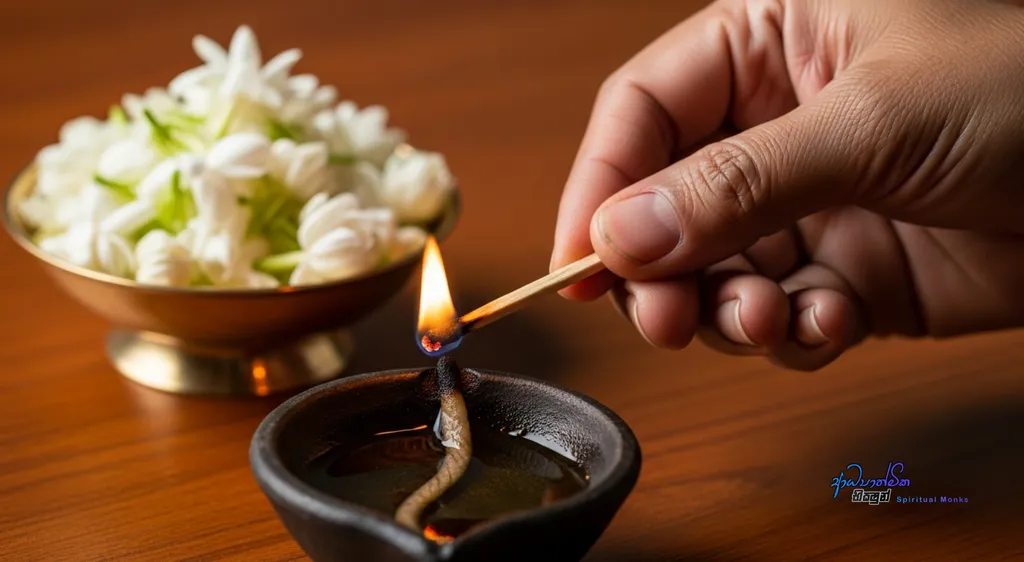
Now, let’s continue this mindfulness practice while you are walking around your home or yard. Go to your shrine or another suitable place and light an incense stick. If you don’t have one, you can use a perfume or any scented item. Pay attention as the fragrance reaches your nose.
While watching your mind, experience the scent fully. If you lit incense, mindfully inhale its aroma. You walked to this spot while watching your mind, observing sights with your eyes and hearing sounds with your ears. Now, the sense of smell is present. You may notice the fragrance is more vivid than usual. Experience it. Watch your mind as you experience it. All of this is done with your eyes open, not in a formal meditation posture, but while moving and living.
Now, experience any odors as well. If there are any unpleasant smells nearby, perhaps the smell of garbage, experience that too while watching your mind. Don’t just focus on pleasant scents. Experience whatever is present. As you read this on your phone, you can do this while my voice is also in the background. You will notice the scent arising, lingering, and fading away. You will be clearly aware of whether the scent is still there or not. This clear understanding, this knowing, is what we call wisdom, or Paññā.
Next, find something to eat, perhaps a biscuit or a small piece of food. While watching your mind, put it in your mouth and chew it thoroughly. The tongue is what senses taste, both pleasant and unpleasant. Mindfully put the biscuit in your mouth and chew. As you chew, you will be acutely aware of the taste. You will notice how long the flavor lasts and when it disappears.
If you like, have another. Continue to watch your mind as you eat and savor the taste. You might feel a strange or new sensation today, which is perfectly fine. The key is to do this while watching the mind. If your mind wanders, you will notice that as well. If you feel thirsty, mindfully walk to get a glass of water and drink it. Feel it on your tongue, notice how it quenches your thirst, and observe how it washes away the taste of the food. Experience this with full awareness. This is what we call maintaining mindfulness.

Exploring the World of Touch and Sensation
Now we have explored the eye, ear, nose, and tongue, four of the sense doors. Find a place where you can feel the wind on your skin, perhaps in your garden, on a balcony, or on an upper floor. Walk there while keeping your mind in view. If you cannot find a breezy spot, you can turn on a fan or air conditioner. Do this mindfully, watching your mind as you act. Once you are in position, watch your mind and notice the sensation of the wind on your body.
Feel the air touching your skin. Notice if it feels cool. Observe this sensation clearly. See how long the feeling lasts. Also, mindfully touch different things around your home. Try stroking your own arm. As you gently rub your skin, what sensation do you feel? Do this while watching your mind. You may feel an unusual sensation compared to other times.
You might also notice that your movements have become slower. When you first start this mindfulness practice, everyday actions can feel slow, almost robotic. This is simply because you are not used to observing your mind so closely. It’s a temporary phase. With practice, you can return to a natural pace. For now, continue with this slower, deliberate pace. Touch a rough cloth and then a smooth one.
If you are with a loved one, you can mindfully hold their hand. Notice the difference in textures. As you do this, you will clearly distinguish between pleasant, unpleasant, and neutral sensations. A soft texture will be known as soft, a rough one as rough. A pleasant touch is felt as pleasant, and an uncomfortable one is felt as uncomfortable. Continue this mindfulness practice with the sense of touch.

Mindfulness in Every Action and Posture
We have now practically trained with all five physical senses: eye, ear, nose, tongue, and body. Throughout these exercises, I have encouraged you to walk while watching your mind. Can you now walk while continuously watching your mind? It is entirely possible. As you walk, can you mindfully sweep the floor? Go and pick up a broom, and see if you can sweep while watching your mind.
You will find you can sweep better than ever before. Go to the kitchen sink, and while watching your mind, turn the tap on and off. Raise your right arm while watching your mind, then lower it. Do the same with your left arm. Your movements may feel slower, but as mentioned, this is due to the newness of the focused mindfulness. Watch your mind as you lift and lower your arm. Walk to the tap, mindfully extend your hand, turn the handle, and turn it back off. Pick up your phone, watching your mind as your hand moves. Guide every action by watching the mind.
This is what we call mindfulness of postures, or Iriyāpatha, being mindful of all bodily actions. First, you were mindful of the senses. Now, you are mindful of physical movements. Walk around your home. Do everything while watching your mind. Notice the lifting and placing of each foot. Open a curtain, a window, or a door. Watch your mind as your hand moves to the window, unlocks it, and opens it. Use your smartphone, touching the screen, scrolling up and down, all while watching your mind. Whatever you do, guide your actions by observing the mind.
Observing the Mind and the Nature of Consciousness
As you continue these activities, sweeping, walking, moving, also look directly at the mind itself. Look at your consciousness. All these words point to the same thing. Look at this mental sense organ. While you are engaged in these actions, you will notice different things being remembered. Past thoughts arise. Watch the mind closely. Thoughts from the past appear. Now, the mind is not just focused on the five senses. When there are no strong inputs from the senses, the mind brings up memories or plans. You might remember something you need to do next, a trip you have to take, or chores like cooking. You’ll see thoughts about the future.
However, when you are watching the mind very closely, these thoughts often don’t arise. It’s as if they are blocked or have stopped. You might feel a great sense of lightness and relief. You may think, “There is such peace in this! The usual problems aren’t coming up.” It can feel like the same peace you find in formal meditation, but now you are experiencing it with your eyes open, while moving through life.
Whether you feel this peace or not, just continue to watch your mind and recognize the thoughts that arise. See them for what they are, just normal thoughts that come and go. At times, you may even notice the mind is completely empty. Watch that too. At other times, it is not empty. Just keep observing.
You have now used all six sense doors, eye, ear, nose, tongue, body, and mind, and directed your mindfulness toward them. You have grasped the method, the technique. This mindfulness practice has no barriers of nationality, religion, or age. You have been given the ability to see this for yourself.
Bridging Daily Practice with Formal Meditation
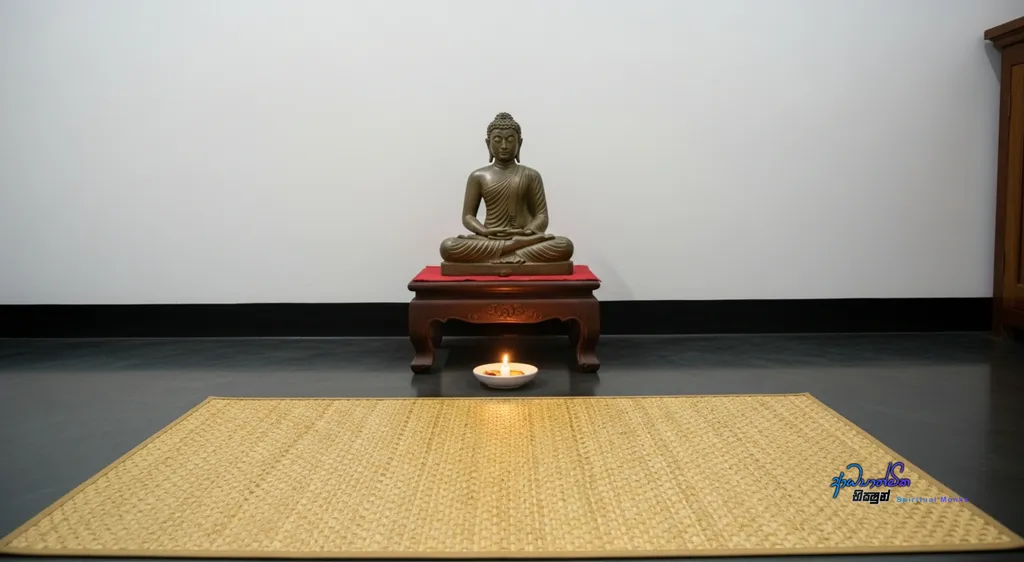
Now, while maintaining this mindfulness, walk to the place where you usually do your formal meditation. Go to your meditation seat. We have introduced several types of calming (Samatha) meditation before, such as the “Third Eye” practice, the practice for attaining higher realms (Brahma worlds), and breath meditation (Ānāpānasati). You may be practicing one of these. While watching your mind, go to your spot and sit down. Fold your legs comfortably, whether in a half-lotus or full-lotus posture. Do all of this with full awareness, watching your mind.
As you settle in, you might find my speaking voice distracting. That’s okay. Just remain mindful. You may also notice that you have less desire to speak. Your speech has likely reduced during this practice. To an outsider, your slower, more deliberate movements might be noticeable. There’s a normal speed for sweeping, and then there’s a rushed speed. Practice doing things at your normal pace, but with this added mindfulness.
When you must rush, do it while watching your mind. This training can be integrated into any activity. Through this, we learn to identify feelings, which is known as Vedanānupassanā (contemplation of feelings). You recognized pleasant sensations like the wind and unpleasant ones like a rough texture. This is part of the training. You have also practiced Kāyānupassanā (contemplation of the body) and Cittānupassanā (contemplation of the mind). Don’t worry too much about these Pali terms. The practical exercise you’ve just done is what’s most important.

Understanding Effort, Fatigue, and Letting Go
The final foundation is Dhammānupassanā, or the contemplation of mental phenomena. This includes recognizing when energy is low, when laziness arises, or when you feel difficulty in continuing the practice. You have now been engaged in this mindfulness practice for around forty minutes, maintaining a strong, intense focus. Because you engaged the mind so suddenly and forcefully, it can feel strenuous.
You might feel a bit tired and think, “What a hassle to maintain mindfulness like this!” You might feel the urge to let it go. If you do, that’s fine. Watch your mind as you let it go. If the mindfulness feels like a burden, a strain, or a fatigue, release it for now. However, you might find that even after you let it go, it comes back on its own. If it returns, just allow it to be there.
Even after this guided session ends, try to continue this mindfulness practice. You will find that the initial feeling of pressure or strain can lessen. When you first started, it might have felt light and novel, but after 45 minutes, a sense of difficulty can arise. Even if you release it, mindfulness may return. The key is to integrate this into your life. When you take a plate to eat, do it mindfully. Serve your food with awareness. Mix the curries, put the food in your mouth, and mindfully experience the taste on your tongue and the feeling of it going into your stomach.
As you continue this mindfulness practice, you will naturally speak less. You won’t feel the need to engage in pointless chatter. You may also find you eat less. This won’t happen overnight; it’s a gradual process. If you used to listen to twenty songs a day, the number will slowly decrease. If you watched many movies, they may start to seem meaningless. Your attachment to the pleasures of the sensual world will slowly diminish. If you held onto hatred, you will feel the urge to let it go. If you were strongly attached to someone, that too will lessen.
The Path to Freedom: Recognizing and Releasing Defilements
As you continue to watch your mind, you will be able to separately identify attachment and aversion arising through all six senses. In our other teachings on mindfulness, we explain how to recognize these states. You will see, “Ah, I am attached to this,” and you can observe for how long the attachment lasts. When a man sees a beautiful woman, he can watch his mind to see if attachment arises. He can then watch to see that attachment fade away. Similarly, when seeing an enemy, one can watch to see if aversion arises in the mind.
Whatever you are naturally drawn to through your senses, sights, sounds, smells, tastes, touches, you can intentionally observe them and see if the mind becomes attached. Likewise, you can observe things you dislike and see if the mind reacts with aversion. When you mindfully recognize the nature of attachment and aversion as they arise, they begin to weaken. This is what we call the purification from defilements (Kilesa). Your defilements are gradually eliminated.
The intense mindfulness I mentioned earlier, the one that felt like a burden, might have faded. But now, you may find that you are still in a mindful state, but without the strain. Continue to practice in this way. This has been the first practical training session on “Watching the Mind with Mindfulness.”

Final Encouragement for Your Journey
Remember, it is very difficult to maintain this level of mindfulness continuously. You will inevitably become unmindful at times. When that happens, simply recognize, “Now my mind is unmindful.” The very act of remembering that you were unmindful brings you back to mindfulness. A practitioner of this path develops the ability to quickly realize, “I was not mindful for a while,” and return to the practice.
When you get caught up in a conversation, for instance, you can lose mindfulness. But with practice, you can speak while watching your mind. You can listen attentively and respond only with necessary words, avoiding useless chatter. Your desire to talk will decrease. As we’ve mentioned before, any deep meditation practice, whether for calm or insight, leads one away from worldly entanglements.
This is especially true for insight practice, a wisdom-based meditation, which is the most noble path. The endless cycle of birth and death (Saṃsāra) is not stopped by socializing. You have associated with countless beings over innumerable lifetimes, yet you have not realized liberation (Nibbāna). This mindfulness practice is your opportunity to do so. Instead of wasting time, engage in the Four Foundations of Mindfulness, in Vipassanā, in purifying the mind.
Again, you cannot force mindfulness to be present all the time. It must be cultivated little by little. Times of unmindfulness will be more frequent at first. But the ability to recognize that and return to mindfulness is the key. Please practice this and feel free to share your experiences, as your insights can be a great help and encouragement to others.
We will provide more teachings in this series. This concludes the first practical training on “Watching the Mind with Mindfulness.” May the power of the Buddha, Dhamma, and Sangha, the Triple Gem, bless you and give you the strength to continue this training.
We invite you to walk this path with us. Read our teachings, and most importantly, apply them practically in your own life. as you practice, questions will naturally arise. Please feel free to share your experiences and questions in the comments below, via email or contact form. I will do my best to offer guidance in future talks based on your progress. For now, begin this practice with an open heart and a mind free from expectation. Cultivate it correctly, and may you find the clarity and peace you seek.
Thank you for joining us. We hope this blog will be of great benefit to your spiritual journey.
May you all be well and happy.
May the blessings of the Triple Gem be with you all!.


