


Categories: Maintaining Mindfulness
May the blessings of the Triple Gem be with you all!
Today, we will explore a topic close to the hearts of many who embark on a spiritual journey: how to begin when life itself feels overwhelming. People are drawn to a spiritual path for two main reasons. Some are driven by a pure desire to explore the nature of existence, and their worldly lives may be relatively free of major issues. However, the vast majority of us turn toward spirituality because we are facing significant challenges. We seek solutions and relief from the intense pressure of our problems.
These worldly problems can take many forms: difficulties in your relationships, struggles within your family life, financial hardships, or perhaps regrets over past mistakes that have caused friction with loved ones or colleagues. It is often the weight of this stress, this deep feeling of unsatisfactoriness that Buddhists call Dukkha, that guides us toward seeking a deeper truth. There is absolutely no fault in coming to a spiritual path from a place of pain.
Even in the time of the Buddha, many people sought him out not initially for enlightenment, but to find a way to deal with their immediate suffering. This article is for those of you who have been led here by the pressures of life, and it offers a practical starting point for your journey of healing and discovery.

Two Gateways: The Path of Devotion and the Path of Practice
When faced with hardship, our first instinct is often to engage in religious or devotional acts. In the Buddhist tradition, this might mean going to a temple and making an offering at a sacred Bodhi tree, known as a Bodhi Puja. This is a beautiful way to honor the Buddha, recalling his virtues and his service to the world. We find comfort in these acts, which are called Amisa Puja, or the offering of material things. There is nothing wrong with this; it is a natural human response, and you can see people finding solace this way at sacred sites like the Atamasthana and Solosmasthana in Sri Lanka.
However, the Buddha taught that there is a more profound offering: Patipatti Puja, the offering of practice. This is meditation. Not everyone, even those born into a Buddhist culture, immediately feels the urge to meditate, to attain the states of deep absorption called Jhana, or to realize Nibbana (liberation).
The world is diverse. Some non-Buddhists are drawn to Buddhist rituals, while others, Buddhist or not, are drawn directly to the practice of meditation. Our guidance has never been to stop devotional acts, but to gently shift our focus. While continuing with these rituals in a smaller way, we encourage dedicating more time to the practice of meditation. This is because the most powerful way to generate positive mental energy and overcome our difficulties is through the cultivation of the mind itself.
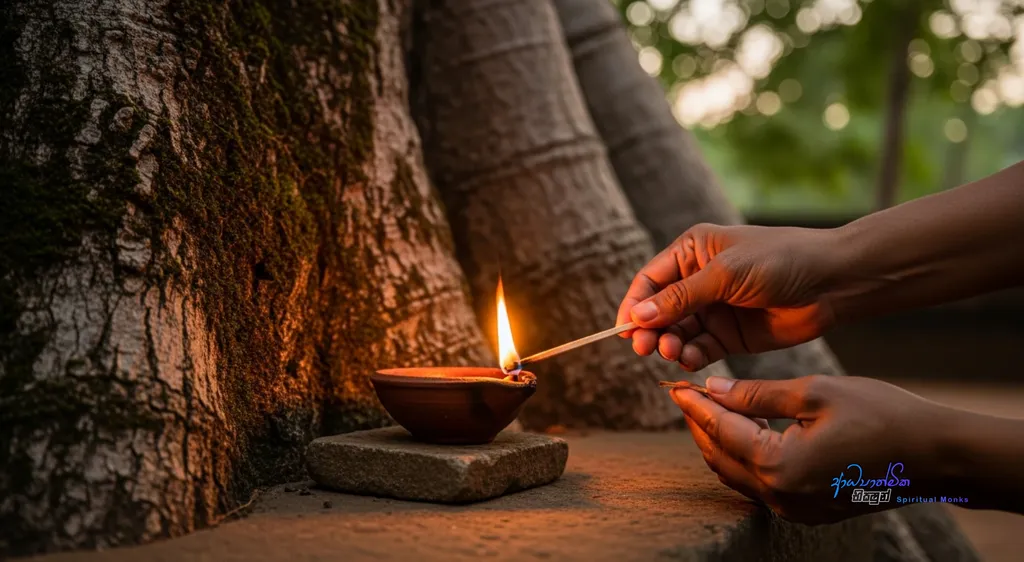
The First Obstacle: When Your Problem Hijacks Your Meditation
So, you decide to try meditation. You’ve been drawn to the spiritual path by a pressing problem, a painful breakup, a mountain of debt, a family conflict. You sit down, ready to begin. Perhaps you try to focus on your breath, a practice known as Anapanasati, or another technique you have learned. But instead of peace, you find a battle. The troublesome thought, the very reason you sought meditation, returns again and again. It hijacks your attention, pulling you away from your breath or your point of focus. It feels impossible to concentrate.
This is an incredibly common and frustrating experience. The reason it happens is simple: the mind is tormented by that specific issue. The problem has become the most powerful, dominant force in your mental landscape due to the immense pressure it exerts. For someone coming to the practice without such an immediate, burning issue, focusing on the breath might be relatively straightforward. But for you, the mind is locked onto the problem. Trying to force it away is futile; the thought is too strong. It is the main ‘virus’ infecting your system, and until you address it directly, no other practice can take root.

The Direct Antidote: Applying Mindfulness to the Painful Thought Itself
Here is the key piece of advice for this situation. The most effective medicine is not to ignore the illness but to treat it directly. Instead of trying to force your mind onto the breath or a mantra, you must apply the medicine of mindfulness directly to the problem itself.
The practice is this: sit comfortably, either on a cushion or a chair. When that nagging, painful thought arises, the thought of your debt, your heartbreak, your failure, do not fight it. Do not push it away. And equally, do not intentionally invite it or get lost in its story. Simply turn your awareness towards it and watch.
Observe it with Sati, or mindfulness. Notice it as a mental event. See it appear in your mind. Feel the pressure it creates. Acknowledge its presence without judgment. Your only job is to watch it with a clear, steady attention. This is the ‘injection’ for the ‘main virus.’ You are directly targeting the source of your suffering not by destroying it, but by understanding it through mindful observation.
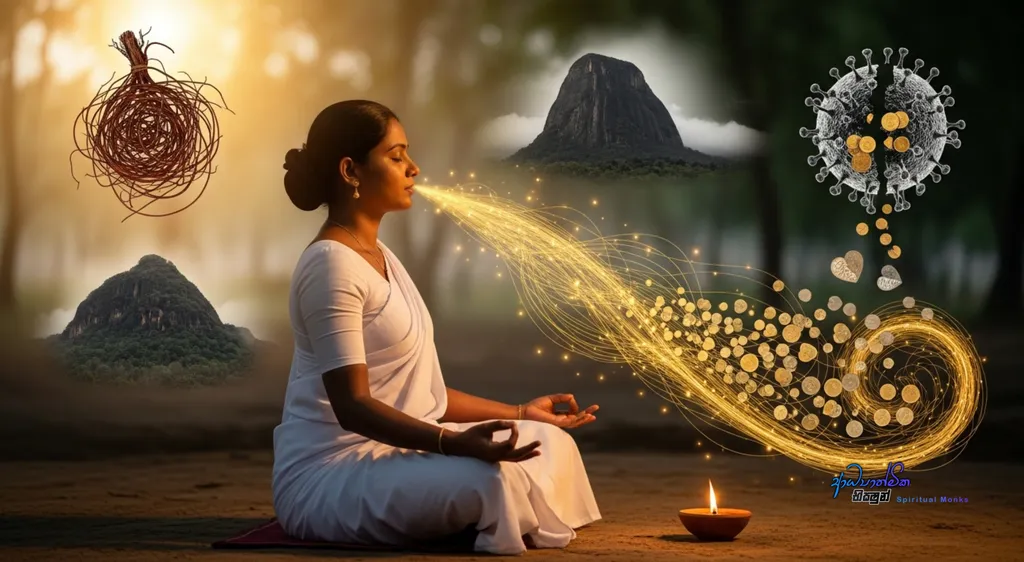
Watching the Thought: How Observation Diminishes Its Power
What happens when you consistently practice this? As you continue to watch the painful thought, you begin to perceive its true nature. You will see that the thought is not a solid, permanent thing. It arises, it ‘dances’ in your mind creating pressure and pain, and then, eventually, it fades away. It comes, it stays for a while, and it goes. This is its natural characteristic. By observing this cycle repeatedly, you are directly experiencing a profound Buddhist truth called Anicca, or impermanence.
As you recognize this impermanent nature, the thought’s power over you begins to weaken. The ‘dense energy’ or ‘solid’ feeling of the problem starts to thin out. It becomes less potent. It is crucial to understand this: you can never forcefully stop a thought from arising. That is not within our power.
What we can do is change our relationship to it. When you mindfully watch it, you stop feeding it with your resistance and fear. Over days and weeks of this practice, you will notice that the thought, which used to torment you for minutes at a time, now feels less intense and its visits become shorter and less frequent. You are not killing the enemy; you are understanding it so deeply that it ceases to be an enemy.

From Coping to Liberation: The Lifelong Journey of Practice
This practice of applying mindfulness for anxiety is not just a coping mechanism; it is a gateway to profound freedom. Once the primary mental obstacle, that dominant, painful thought, has been weakened, your mind becomes clearer. Then, other concentration practices like Anapanasati (mindfulness of breathing) become much easier. You might even progress to deeper states of peace and concentration, known as Jhana. Even for advanced practitioners, a worldly problem can arise and block their progress. The solution is always the same: turn your mindfulness directly to the obstacle.
However, it’s important to have a long-term perspective. As your mental pressure lessens, do not abandon the practice. It is a rare and precious opportunity to be born human and encounter these teachings. Life, or what we call Samsara, the endless cycle of birth and death, is fundamentally filled with challenges.
Problems will never cease entirely. We age, we get sick, our bodies fail us. If you stop practicing once the immediate crisis is over, you will be unprepared for the next one. So, continue to develop your mindfulness.
The goal is to strengthen the mind to such a degree that even when external problems exist, they no longer create suffering inside you. You reach a point where you look at what once tormented you and think, ‘Is this even a problem?’ This is true mental freedom.
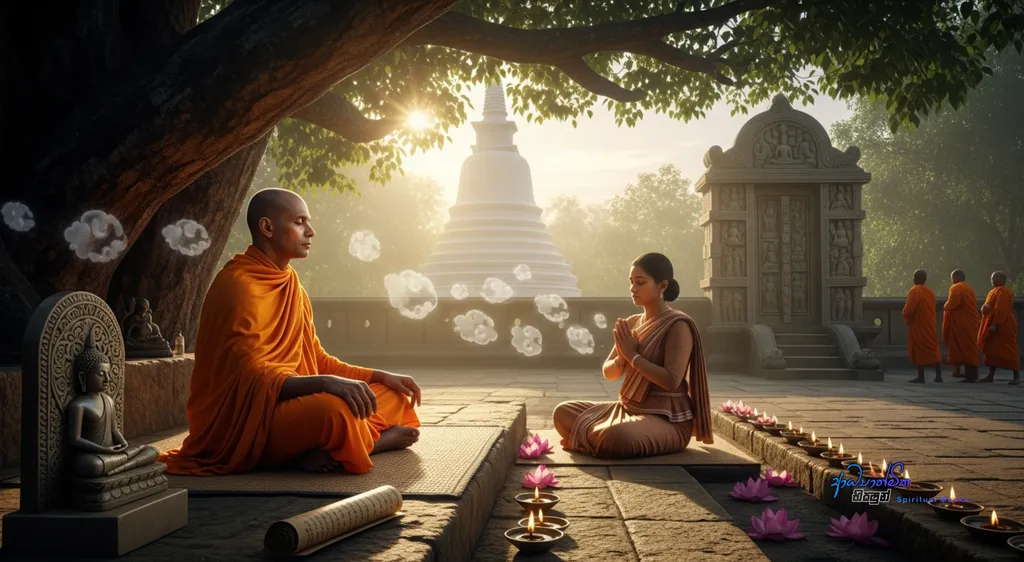
A Final Encouragement: Face Your Mind with Courage
This teaching was shared because many people who start meditation due to life’s problems tell me, ‘I can’t concentrate.’ The issue is almost always a powerful, underlying problem that needs to be addressed first. Talking about the problem with someone can bring temporary relief, but it is often short-lived. The true, lasting solution lies within your own practice. Whether you are sitting in meditation or lying in bed, you can develop your mindfulness by turning your attention to whatever is causing you pain right now.
Let the external problem exist in the world. But do not let it become a problem in your mind, in your consciousness. Face your thoughts directly, like a person of courage who deals with things head-on, not indirectly like a coward who attacks from behind. Be a person of integrity and strength in your inner world.
As you practice watching your thoughts with steady mindfulness, their power will diminish. When the mind is free, external issues lose their weight. You can develop the capacity to face anything life throws at you with a strong and peaceful heart.
May you all gain the strength to understand these teachings and put them into practice.
We invite you to walk this path with us. Read our teachings, and most importantly, apply them practically in your own life. as you practice, questions will naturally arise. Please feel free to share your experiences and questions in the comments below, via email or contact form. I will do my best to offer guidance in future talks based on your progress. For now, begin this practice with an open heart and a mind free from expectation. Cultivate it correctly, and may you find the clarity and peace you seek.
Thank you for joining us. We hope this blog will be of great benefit to your spiritual journey.
May you all be well and happy.
May the blessings of the Triple Gem be with you all!.


