


Categories: Maintaining Mindfulness
May the blessings of the Triple Gem be with you all!
Today, through our spiritual exploration, I wish to illuminate another aspect of your own mind. We will look at how to maintain mindfulness in a way you might be familiar with but also explore a perspective you may not have seen before. This teaching will show you how to identify what is truly happening within your mind.
The focus of our reflection is this: Let’s eliminate the desire and dislike for our thoughts. According to this theme, you inevitably engage with the thoughts in your mind. To put it simply, you either desire them or you clash with them, you get angry or feel aversion toward thoughts you dislike. This is a common experience for all beings in this world. The teachings of the Buddha help us understand the torment our thoughts inflict upon our mental state.
For many people today, the primary cause of their mental suffering is the failure to recognize their own thoughts and the pressure these thoughts exert. Our minds are afflicted by the various things we let in from the worldly realm, the things you see and experience.
What do you experience? In this world, there are many things you experience with desire.
At the same time, there are things you are forced to experience with displeasure. This cycle of `craving and aversion` can be connected to everything: your children and grandchildren, your spouse, your job, society, friends, relatives, siblings, your financial situation, your education, all these things have entered and settled in your mind. They engage in certain activities there.

How the Mind Creates Our Suffering
What are these activities?
When such worldly impressions enter our minds, they become stored. They linger. These lingering thoughts then surface at various moments in our lives, and as we go about our day, they emerge and ‘attack‘ us. This often happens when we are not actively engaged in a task, either physically or mentally.
When we are alone, in solitude, this attack begins. Everything you have ever done or said in your life can be brought back up by your mind. It presents past events and even future anxieties, leading you to a point where your own mind causes you to fall, to experience mental pressure, and even to feel a sense of madness. This is the nature of the mind.
So, please take your time as you read these words carefully. If there are distractions around you, try to find a quiet place to focus on the content of this article. Settle your mind and pay attention to what is being explained. As I mentioned, when your mind overwhelms you with these thoughts, you experience various forms of pressure.
In this teaching, I hope to show you how our own thoughts torment us because we desire them (craving) and because we clash with them (aversion). I want to show you how we become sad, how we grieve, and also how we become happy, all because of this process of `craving and aversion`.
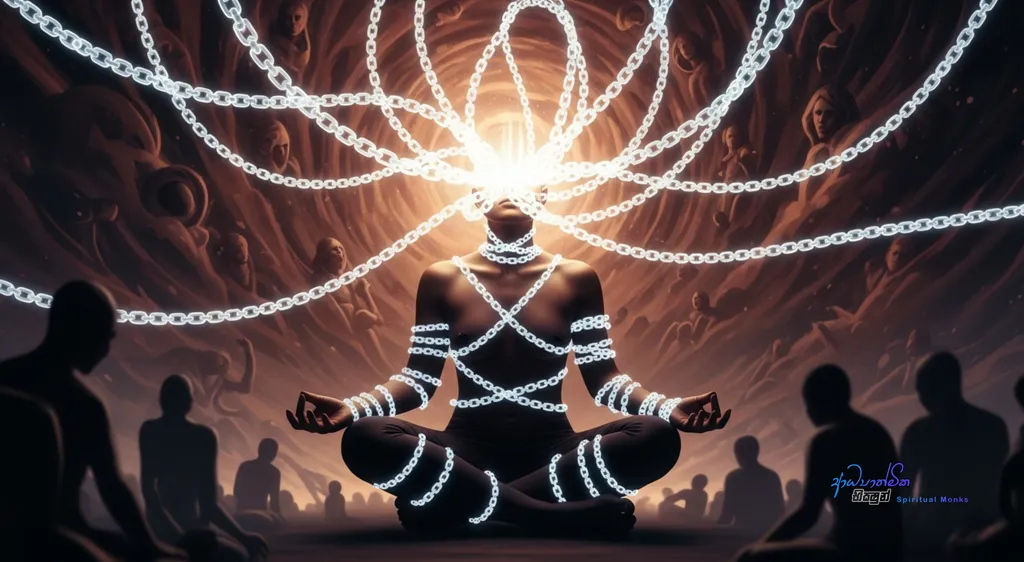
The Sweet Trap: How Craving for Pleasant Thoughts Creates a World
Think about the times in life we spend with love,with our children, spouse, parents, siblings, friends, and community. We have many moments we spend lovingly. Let’s take an example. Imagine you are talking with your romantic partner, and they say something kind, like “You are so beautiful,” or they praise one of your good qualities.
That praise sinks deep into what we romantically call the heart, but in reality, it sinks into the mind. You become happy just from that. Even after they have dropped you off, or while you are riding the bus home, you keep thinking about it and feel joyful. You arrive home still happy. You can work with great enthusiasm. Even when you go to bed, you daydream. You savor that single thought again and again.
There is no problem with this, you feel uplifted, joyful, and happy in that thought. But look closely with mindfulness at how you became so attached to that thought. You are incredibly fond of it. You relish it repeatedly. After a while, we can’t even stop it; the thoughts come in a continuous stream.
And there’s no issue, no headache, the head feels relaxed, and you can even get work done. People around you might even ask, “What world are you in?” They ask because you are indeed in another world. At that moment, your world is that person and the words they spoke.
You are holding onto the part of that experience you loved the most. Observe this with mindfulness. See how you savor it again and again. This applies to everyone. If younger people who haven’t experienced romantic love are reading this, they can apply it to the things in their life they are most fond of. Adults with these experiences can relate directly.

When Joy Turns to Pain: The Sting of Aversion
But what happens if, at some point, you lose this thing you desire so much? Have you ever thought about that? Imagine that person is no longer there. What happens then? All the words they said come rushing back. ‘They left me.‘ ‘They must be with someone else now.‘ ‘They must be saying the same things to them.‘ These thoughts arise within you, constructed by your own mind.
You, see? The words you once let in through your ear now have a new role after the relationship ends. The mind generates a new set of thoughts: ‘He must be saying that to her,‘ or ‘She must be saying that to him.‘ The mind provides this new narrative. If we dislike thinking about it, we clash with it. The Buddha teaches that we constantly clash with or feel aversion towards, that thought. This is the other side of `craving and aversion`.
As this clashing continues, we develop headaches. A pain in the head arises, our forehead tenses, the body feels weak. We lose our appetite. Such things happen. I use the example of a romantic relationship because many young people read these teachings and it’s a common experience today.
But even though I highlight this, I urge you to apply this same mindful observation to all your other issues, your financial problems, your family issues, social problems, national issues. Look at everything with this same clear mindfulness. Observe the process with things that make you happy too, like going on a trip or to a concert, or the joy some people feel from giving charity. Look at these thoughts.

Your Mind, Your Master? How We Become Enslaved by Thought
Following the earlier example, your own mind generates sorrowful things and delivers them to you. If you had an argument in your last moments together, the mind would bring that up too, replaying it vividly. Your mind takes control of you, without any check. All beings in this world, be they gods (devas), celestial beings (brahmas), serpent beings (nagas), hungry ghosts (pretas), animals, or any being in the lower realms, are subject to this if they haven’t understood this principle, this Dhamma taught by the Buddhas.
Unless they have understood what the Buddha taught, all humans who don’t grasp this truth live enslaved to the mind. They are caught by the mind. The mind controls us, and we are forced to endure the suffering, the stress or Dukkha, that the mind delivers.
The mind provokes you about your past relationship in various ways. It tries to control you through different masks. And indeed, we are controlled. See this. As you see this more and more, you will be able to observe how your mind attaches, desires, and clashes in all your various problems and issues. This is the cycle of `craving and aversion`. I spoke about this in a previous teaching on how mindfulness strengthens memory. And in this teaching today, I am trying to show you that everything is in our mind.

The External World vs. Your Internal Reality
Think about it. Physically, your children exist. That’s true. You have land, vehicles, money, all these things exist. Your parents exist. All these are external. Now, just look with mindfulness. That external person, your partner, your beloved spouse, they all exist externally. The wealth you worked so hard to earn is all external.
Look at all these external things with your own two eyes. You will see that they are outside of you. But the feeling of ‘I desire this‘ arises in my mind. The eyes see, but it is my mind that desires. The desire is not in the external object itself.
Imagine a pile of money in front of you. Or perhaps you love clothes, or technology. We all have different preferences. Maybe you are drawn to men or women, to makeup, furniture, houses, land, or vehicles. Look at those things. When your eyes see them, notice how your mind reacts. You will see that your own mind produces a thought of desire. It is your mind that says, ‘This is beautiful.‘ It is your mind that says, ‘If you can, get it. Make it yours.’
Watch this process carefully. The more you watch, the more you will understand the true nature of your mind. This is what the Buddha taught us to observe. As you watch, you will see for yourself how your mind grasps onto these things.
You will understand that your mind holds onto them and reproduces them, especially when you are alone and idle. This is a common problem for older people who are retired. After their work life ends around age 60, everything they did for those 60 years is stored in their mind’s ‘database.’ Those memories come and attack them. If you practice this observation now, then after you turn 60, you can live in bliss and peace. If you understand the workings of your mind now, you can die peacefully. Otherwise, you cannot.

The Source of Anger and Desire: A Look Inside
Now consider things that make you angry. Imagine there is someone outside of you who has wronged you. You have been treated unjustly, though you did nothing wrong. One day, you see that person on the bus. You see them with your eyes. But look, the moment you see them, your mind instantly erupts: ‘There goes that dog, that scoundrel!‘ Observe the words that arise, sometimes even with profanity.
Look closely. Where is all this happening? You will realize it is all generated within your own mind. Because of the injustice that person did, seeing them with your eyes and hearing with your ears triggers this internal reaction.
The Buddha taught us about five doors: the eye, ear, nose, tongue, and body. In the Abhidhamma and the Sutta Pitaka, these are explained as the gates through which we take in the external, physical world. We bring it into our mind through these five doors. Once inside, these things get stored. Then, when we encounter these physical things again, we make decisions based on our stored data.
For example, as a child, someone shows you a chair and says, ‘This is a chair.‘ That word enters through your ear while you see it with your eyes, and you store it in your mind.
From then on, wherever you go in the world, whenever you see a similarly shaped object, your mind identifies it: ‘chair, chair, chair.‘ You see how simply you recognize it? It’s because of what you stored in your mind. Therefore, everything that mentally torments us is something we ourselves have taken in.
The things we cling to, the things we are attached to, are what give us pain. The things we clash with, the things we dislike, we have piled all this garbage into our own minds. That is why I titled this teaching: Let’s eliminate the `craving and aversion` for thoughts.

The Buddha’s Wisdom: Desire is Born from Our Own Mind
The anger towards that person I mentioned, they are outside, but the anger arises inside, in the mind, in the heart. It is not their fault; the fault is ours. We need to eliminate the anger. When we see something, we like, such as a car, we get attached. We desire it. But the car itself has no fault. As I have taught before, people might feel lust when they see a woman, or a man, dressed in a certain way.
The Buddha gave a verse for this: Na te kāmā yāni citrāni loke, saṅkappa-rāgo purisassa kāmo. I won’t go into a deep analysis, but the meaning is that there is no inherent lust in the beautiful things of the world; a person’s sensual desire (kāma) is born from their own thought-based passion (saṅkappa-rāgo).
Just like that, if you look at a woman dressed revealingly and lust arises in your mind, that lust is in you. The woman has no fault; she is just dressed as she is. We are not here to discuss cultural or moral propriety, that’s her issue and I have no right to speak on it now. We are talking about the mind.
So, if you see such a woman, and to be fair to the women, if you see a man, you find attractive, and you feel desire, or affection, or even sexual lust, all of that arises within your own mind. It is all happening in your heart. Look at this process very carefully. Observe it with mindfulness. As you watch, you will be able to identify this internal process of `craving and aversion`.

The Path to Freedom: Turning Your Enemies into Teachers
Practice this every day, 24/7. As you do this again and again, let’s return to our example. The person who wronged you,let’s say you see them on the bus every day. That person becomes your greatest meditation object, your best spiritual focal point, which in Buddhism we call a Kammaṭṭhāna. Nothing in this society or environment is actually wrong with us. The problem lies in the angle from which we view it. So, let’s fix our angle.
As you see this person every day, a day will come when not even a mustard seed’s worth of anger arises in your mind. You can reach such a day. And if you understand this with one thought, that is enough. After that, even if the whole world turns against you and becomes your enemy, you can remain, as we say, in ‘full bliss.’ Why? Because you have understood the nature of that one thought. You will categorize all the hateful thoughts that arise into that same category. Simply put, this is a study of the mind, and it can only be learned through mindfulness (Sati).
When you mindfully face the experience with a romantic partner, you understand it practically. After that, if you have relationships with ten different people, you will understand the pattern in all of them. You might even enter a relationship knowing this, and if it ends, there is no special sadness. However, there is an important distinction here.
When I say, ‘no sadness,‘ I don’t mean the way some people avoid pain by grabbing onto someone new before letting go of the old one. That’s not true letting go; you’re just replacing one pleasure with another.
I’m talking about something different. Imagine the relationship ends, either by your choice or theirs. You don’t grasp for another pleasure. Instead, you watch your own mind, ready for anything, because you have done this training. Your mind is ready to be alone for the rest of your life, if need be, because you understood that one thought.

Like a Bar of Soap: The Slow and Steady Path to Liberation
This is the point I wanted to show you. You desire your own thoughts. By now you should understand that all our `craving and aversion` is directed at our own thoughts. When we lie in bed and ponder, we are desiring and clashing with our thoughts. All you need to do is understand them. That’s it.
What always comes to torment us is a thought. It’s thoughts that dig up our past, stir up things we dislike, and torture us again and again. It’s also thoughts that stir up things we like, making us wish we could have them back. This is why many older people wish they were young again; they remember their past and want to relive it.
There’s a common saying among the young: ‘You have to have fun, this body is decaying, so let’s get our thrills now.‘ My advice is this: enjoy life, have your fun. There is nothing wrong with experiencing the world. But remember, when you get older, you will have to experience the consequences of those actions two or three times over in your mind. If you practice this mindfulness now, when you are old, you will neither have to revel in the past nor suffer from it.
You can spend your time with mental peace. You can’t do the same things you did when you were young, so while you live your life, practice what I am saying. As you practice, you will begin to understand the reality of this world, the truth of the Dhamma, and the validity of the teachings of the Buddha. You will see that this is all a matter of thoughts.

The Ultimate Truth: Everything is Experienced in the Mind
By now it should be very clear that the entire issue is a problem of thoughts,of `craving and aversion`. Physical pains like fever and colds are real. But examine them. When you observe with mindfulness, where do you feel them? You feel them in your mind. When someone scolds you, where do you feel it? In your mind. When someone praises you, where do you feel it? In your mind. If you get a bonus, where do you feel that happiness? In your mind.
To put it simply, even when engaging in sexual activity, either alone or with a partner, where is that pleasure truly felt? It is felt in the mind. Although you are physically involved, the experience is converted and felt as a mental sensation.
In the Abhidhamma, feeling (vedanā) is mentioned as a universal mental factor (sabba-citta-sādhāraṇa-cetasika) that arises with every moment of consciousness. Where do we feel this sensation? It is all felt in the mind. Study this well.
When we are idle, not taking in any new information through the five sense doors, just lying in bed or sitting in a chair staring blankly, our mind attacks. The sixth sense, the mind itself, brings up the most powerful things from our past, both liked and disliked. It reminds you of fun times, and it reminds you of painful times, making you tired, weary, and stressed.
It makes you regret things you couldn’t achieve in the future. Watch this process. Just watch. Then you will understand: ‘My desire is in my thoughts. My aversion is in my thoughts. I suffer mentally because I take all this in without understanding it.‘

A Gradual Path to Freedom and Concluding Blessings
This is one facet I wanted to share for understanding your mind and thoughts through mindfulness. I will offer more teachings in the future to help you look at your mind from different angles. For today, I will conclude without making it too long. The topic was letting go of the `craving and aversion` for our thoughts.
As you continue to watch with mindfulness and understand, it’s like using a bar of soap when you bathe. Over time, it slowly wears away without you even noticing. In the same way, don’t search for spiritual attainments (magga phala). Don’t try to figure out what stage you are on. Don’t search for anything. Your defilements (kilesa) will simply wear away on their own. You will realize for yourself, ‘Ah, I am more developed than before.’ You will see you have developed spiritually, both in tranquility (samatha) and insight (vipassanā).
Many people ask about insight meditation, not yet understanding what Vipassanā is. Simply put, it is mindfully identifying the attachment and aversion related to the thoughts in one’s own mind. Study it and apply it practically. Then you will understand it beyond the word.
Ultimately, this teaching is given to the world only by one kind of master: a Buddha. This Dhamma is contained within the Tripitaka (the Pali Canon) and its commentaries. We share these teachings with you from our own practical experience.
Please understand this and engage with it practically and consistently. Then the truth of this world, the truth of the Dhamma, and the reality of what the Buddha taught will become clear to you.
May the power of the Triple Gem,the Buddha, the Dhamma, and the Sangha,bless you all with the ability to maintain strong mindfulness, to recognize and practically realize this truth about the `craving and aversion` inherent in your thoughts.
We invite you to walk this path with us. Read our teachings, and most importantly, apply them practically in your own life. as you practice, questions will naturally arise. Please feel free to share your experiences and questions in the comments below, via email or contact form. I will do my best to offer guidance in future talks based on your progress. For now, begin this practice with an open heart and a mind free from expectation. Cultivate it correctly, and may you find the clarity and peace you seek.
Thank you for joining us. We hope this blog will be of great benefit to your spiritual journey.
May you all be well and happy.
May the blessings of the Triple Gem be with you all!


