


Categories: Maintaining Mindfulness
May the blessings of the Triple Gem be with you all!
Welcome back to our continuing exploration of spiritual wisdom with the Adhyathmika Bhikshun (Spiritual Monks) platform. As we continue our profound journey through the teachings of mindfulness, I want to share a joyful update. To make these Theravada Buddhist teachings more accessible, we have launched dedicated websites alongside our main platform.
For our Sinhala readers, you can explore our written articles at www.adhyathmikabhikshun.lk. For our international community and those who prefer English, our teachings are available at www.adhyathmikabhikshun.org.
You will always find these links pinned in the first comment and within the description areas of our content for your convenience. We will continue to share regular updates on these platforms. Today, our goal is to delve into a highly practical aspect of our mindfulness series: the profound art of questioning the mind.
Why We Turn to Mindfulness in Modern Life
If you look closely at why people begin to practice mindfulness, you will notice that for the vast majority, it starts with a struggle. Some approach meditation simply to understand what it is. Others seek it for understanding your thoughts on a deeper level. However, many turn to the Dhamma (the Buddha’s teachings) because of the immense pressures of life.
You might be facing challenges in your family life, financial instability, societal pressures, or heavy demands in your education and career. These endless burdens often lead to severe mental stress, physical manifestations like migraines, and various psychological struggles. We have received countless emails and messages from people worldwide sharing how applying these teachings has helped them overcome these exact mental afflictions.
Knowing how much this practice has healed our readers inspires me to take this mindfulness series even deeper. I want to offer you a simple, practical way of questioning the mind that anyone (regardless of race, caste, or religion) can use to find genuine peace.

Mindfulness (Sati) and Wisdom (Panna): Seeing and Understanding
Throughout this 2,500-year-old path mapped out by the Buddha, we have focused heavily on Sati, which translates to mindfulness. Through your practice so far, you have discovered that mindfulness is the gentle light that allows you to observe the various thoughts arising within your own consciousness.
As you progress, a new word naturally emerges: Panna, or wisdom. While mindfulness allows you to see your thoughts, wisdom is what allows you to truly recognize and understand them. If you only read about these concepts in the Tripitaka (the foundational Buddhist scriptures) or study the ancient commentaries (Atuwa and Teeka) without practical application, they remain mere words.
Understanding your thoughts through questioning the mind is an experience that blossoms little by little. It is not just an academic exercise; going deeper and deeper into the mind is a fascinating, deeply rewarding journey that you must experience for yourself.
Understanding the Roots of Attachment and Greed
To begin questioning the mind effectively, we must first look at a deeply ingrained thought pattern that we all possess in varying degrees: Raga (passion or attachment) and Lobha (the unwholesome root of greed and craving).
In everyday language, we often associate “Raga” strictly with sexuality or romantic love. However, in Buddhist philosophy, this clinging encompasses much more. It includes your deep attachment to your children, your love for your parents, and your devotion to your spouse. It also extends to material things, your desire for lands, properties, vehicles, or even your mobile phone. While the love you feel for a child differs from the love you feel for a spouse or a parent, fundamentally, when it involves clinging, it stems from the root of Lobha. Recognizing this is the first step in overcoming attachment.

Facing the Pain of Loss (Dukkha)
Let us look at a practical scenario. Imagine your romantic relationship has ended in a painful breakup or divorce. Or perhaps you have lost a valuable property or a cherished physical object. As a result, you experience a complete mental breakdown. You feel deep sorrow, your stress levels skyrocket, and your daily habits crumble, some may stop eating entirely, while others might overeat irregularly to cope with the pain.
Out of the over seven billion people on this planet, a vast majority, perhaps ninety-nine percent are currently suffering from some form of distress rooted in this very attachment. In Buddhism, this universal feeling of suffering and unsatisfactoriness is known as Dukkha. Right now, as you read this, turn your attention inward. Look at your own mind using your mindfulness. Are you carrying a sense of regret, sadness, or frustration? This is exactly where the practice of questioning the mind begins.
The Practical Steps of Questioning Your Mind
How do we actively practice this?
First, find a comfortable posture. If you can, sit quietly with a straight back in the traditional cross-legged posture (Baddha Paryanka or Padmasana), just as we teach in Samatha (calming) meditation. If you are a busy parent, a working professional, or a student, you don’t always have to sit formally. You can practice this while doing chores, riding the bus, or even while driving, with your eyes open or closed.
Observe your mental state. If you are sad, recognize it. Then, begin questioning the mind by asking yourself softly: “Why am I sad?”
Do not expect an immediate answer. Be patient. It might take five or ten minutes, or even longer, depending on the person. Eventually, your mind will reveal the trigger: “I am sad because of this specific event” (such as a breakup, a scolding from a parent, or losing a device).
Once you receive that answer, ask the next crucial question: “Why am I sad ABOUT this?”
Again, wait. Your wisdom (Panna) will soon illuminate the truth: “I am suffering because I was deeply attached to this person. I clung to this object with craving.” You will realize that your pain is not just about the event, but about your own clinging. This profound realization is the heart of Theravada Buddhist teachings.
The Golden Rule: Look Inward, Not Outward
There is a golden rule when engaging in this practice: We never search for external reasons for our suffering. If a relationship ended or you lost a piece of land, do not ask your mind, “Why did they leave me?” or “Why was this taken from me?”
Finding the external “why” does not cure your internal suffering. We are engaging in a practical mental training rooted in the Satipatthana (The Establishments of Mindfulness) taught by the Buddha over two millennia ago. The goal is entirely internal, to identify why you are attached and to dissolve the inner torment. By questioning the mind internally, you let go of the external drama and focus solely on healing your own consciousness. This brings you back to the present moment, allowing you to live a life full of genuine joy rather than dwelling on past regrets or future anxieties.
Letting Go of Spiritual Timelines
As you begin questioning the mind and gathering these insights, a beautiful sense of comprehension will dawn on you. This is the very same path walked by the great Bodhisattvas and those striving for awakening.
However, you must avoid a very common trap. Do not start this practice expecting to instantly attain the noble stages of awakening, Sotapanna (Stream-enterer), Sakadagami (Once-returner), Anagami (Non-returner), or Arahant (fully enlightened) or the ultimate peace of Nibbana. Furthermore, do not set deadlines. Do not tell yourself, “I will achieve Nibbana by June, July, or August of 2026 or 2027.”
Having a noble goal is important, but clinging to a timeline is just another form of Lobha (craving). If you hold onto these expectations, you will not find peace, and you will miss the subtle joys of the journey. Simply focus on the continuous practice. Embrace whatever small or large realizations come your way with a joyful heart.

Questioning Joy and Meritorious Deeds
Up until now, we have discussed questioning the mind regarding negative states like grief, anger (Dosa), jealousy, and hypocrisy. But did you know this practice is equally vital for positive emotions?
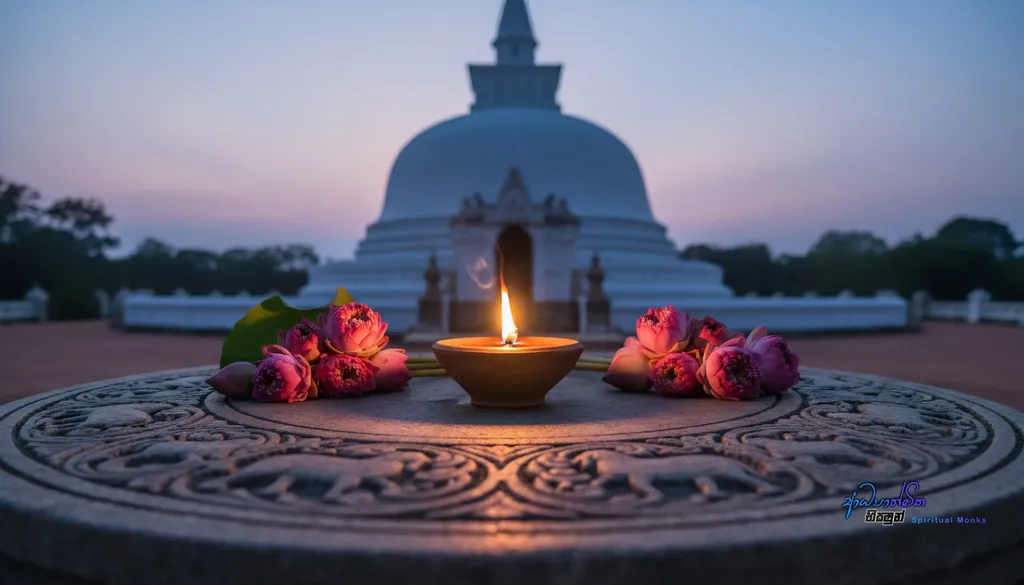
Consider a time when you perform a beautiful act of merit (Puñña), such as offering flowers and oil lamps at a temple (Amisa Puja). The Buddha taught that such acts cleanse and gladden the heart (Hadayang punathi ithi punnan). You feel wonderful. But take a moment to ask: “Why am I so happy right now?”
Some fear that analyzing their joy will destroy their merit. This is entirely false!
When you question this joy, your merit transforms into powerful spiritual wisdom. As the highly revered Venerable Rerukane Chandawimala Maha Thero explained in his writings, doing good deeds without meditating is like a hen that lays an egg but refuses to sit on it, it will never hatch into liberation. Meritorious deeds provide the necessary “fuel” for a comfortable journey through Samsara (the cycle of rebirth) but coupling them with wisdom is what ultimately leads to Nibbana. You might realize, “I am happy because I temporarily let go of my greed and anger to make this offering.” This realization brings an even deeper, unshakeable peace.
Applying Wisdom to Everyday Happiness
You can apply this to all forms of worldly joy. When you feel elated because of a beautiful song, a new romance, acquiring a new property, or even watching an entertaining video on social media, pause and look inward. By questioning the mind about these everyday pleasures, you begin to understand the fleeting nature of worldly attachments.
If these concepts seem difficult to grasp immediately, do not worry. Whether you fully understand it right now or not, the key is simply to start. Practice it. If you are new to our platform, I encourage you to go back and read our foundational articles on mindfulness from the very beginning.
A Lifelong Commitment to Inner Peace
Before I conclude, I want to gently apologize to those whose WhatsApp and email messages I have not been able to answer individually due to my busy schedule. Please know that I read them, and I structure these public teachings to provide the answers you seek.
Make a firm determination today to keep questioning the mind as a practical exercise for the rest of your life. It is the most powerful way to eliminate tormenting thoughts and return your mind to a state of calm balance. In the future, we will explore even deeper topics, including advanced Samatha and Vipassana meditation, the spiritual “Third Eye,” and teachings related to Kundalini and Chakras from a mindful perspective.
My greatest joy as a monk is seeing you elevate your mental state beyond ordinary suffering. Your progress on this path is my true spiritual reward.
May the boundless power and blessings of the Buddha, Dhamma, and Sangha (The Triple Gem) be with you, granting you the strength to understand and practice these teachings deeply. May the blessings of the Triple Gem be with you all!
We invite you to walk this path with us. Read our teachings, and most importantly, apply them practically in your own life. as you practice, questions will naturally arise. Please feel free to share your experiences and questions in the comments below, via email or contact form. I will do my best to offer guidance in future talks based on your progress. For now, begin this practice with an open heart and a mind free from expectation. Cultivate it correctly, and may you find the clarity and peace you seek.
Thank you for joining us. We hope this blog will be of great benefit to your spiritual journey.
May you all be well and happy.
May the blessings of the Triple Gem be with you all!.


